

Safeguarding Adults at Risk Policy(Wales)
The National Energy Foundation (NEF) is a charity that works to improve energy efficiency and assist those in fuel poverty. NEF personnel come into direct and indirect contact with adults in fuel poverty, some of whom may be deemed as ‘adults at risk’ due to care and support needs, through delivery of a range of services including attending events, providing home energy advice visits and managing a helpline. While in the general conduct of its business, NEF staff are not usually in a position of responsibility for adults at risk, we recognise the importance of safeguarding and promoting the welfare of those with needs for care and support.
INTIMATE CARE AND APPROPRIATE CONTACT
NEF does not provide intimate personal care services. Staff and volunteers must maintain professional boundaries at all times. Physical contact should be avoided unless necessary to prevent immediate harm or respond to an emergency situation, and any such contact must be proportionate, appropriate and reported to a manager.
Purpose
The purpose of this policy is to demonstrate the commitment of the National Energy Foundation to safeguarding adults and to ensure that everyone working at NEF is aware of:
- The legislation, policy and procedures for safeguarding adults.
- Their role and responsibility for safeguarding adults.
- What to do or who to speak to if they have a concern relating to the welfare or wellbeing of an adult that they come into contact with.
The National Energy Foundation will
- Promote good practice and work in a way that can prevent harm, abuse and coercion occurring.
- Ensure that any allegations of abuse or suspicions are dealt with appropriately and the person experiencing abuse is supported.
Definitions
The Social Services & Well-being (Wales) Act 2014 defines an adult at risk as someone; experiencing or at risk of abuse/neglect, who has care and support needs and cannot protect themselves because of those needs.
This may include:
- An older person
- A person with a physical or learning disability or sensory impairment
- Someone with mental health needs, including dementia or a brain injury
- A person with a long-term health condition
- Someone who misuses substances or alcohol to the extent that it affects their ability to manage day-to-day living
- A carer, providing unpaid care to a family member or friend
- Adults experiencing domestic violence
- Adults dependent on others for personal care or finances
Abuse is defined as a violation of an individual’s human and civil rights by any other person or persons, including physical abuse; sexual abuse; emotional or psychological abuse; neglect and acts of omission; self-neglect; financial or material abuse; organisational or institutional abuse; modern slavery; domestic violence or abuse and discriminatory abuse.
There are other additional types of harm which are not included in Social Services & Well-Being (Wales) Act 2014 but are relevant to safeguarding adults: cyber bullying; forced marriage; female genital mutilation (FGM); mate crime; radicalisation.
Roles and Responsibilities
All staff, including senior managers, trustees, associates, interns, volunteers, and anyone working on behalf of NEF will be made aware of this policy. However, the policy predominately applies to those who come into contact with adults at risk as part of their professional function.
The National Energy Foundation will:
- Assess the risk of all calls taken on the helpline to determine whether or not the person has care and support needs and, if so, make sure the appropriate actions are taken. As an energy charity, NEF does not intend to take further action than requesting an advocate, referring and signposting adults at risk to, or contacting directly, the relevant Safeguarding Adults team or other statutory agencies or organisations which can identify, prevent and stop abuse.
- When present at events where adults at risk may be in attendance, ensure that NEF is in communication with other parties and organisations in attendance regarding safeguarding. NEF does not intend to take ultimate responsibility for safeguarding adults at risk at such events, as it will generally lie with the event organiser; however, the NEF staff member will make sure that they are aware of the chain of responsibility and which individual/organisation has overall safeguarding accountability.
- When attending home visits, respond promptly and appropriately to any safeguarding concern raised by a Home Visit Advisor and take appropriate actions.
- Make enquiries, or cause others to do so, if it believes an adult is experiencing, or is at risk of, abuse or neglect. An enquiry should establish whether any action needs to be taken to prevent or stop abuse or neglect, and if so, by which statutory agency or organisation.
- Act within legislation on Data Protection and Confidentiality. NEF will usually gain permission from service users before sharing information about them with another agency.
- Pass information to the relevant Adult Social Care service when more than one person is at risk. For example: if the concern relates to a worker, volunteer or organisation that provides a service to adults at risk or children.
- Endeavour to keep up to date with national developments relating to preventing abuse and welfare of adults.
- Ensure that a Designated Named Person is always within post within the organisation.
- Ensure that the Designated Named Person understands their responsibility to refer incidents of adult abuse to the relevant statutory agencies (Police/Adult Social Care Services Directorate).
The Designated Named Person for Safeguarding Adults (Wales) in NEF is -Lisa Callen, Partnership Manager ;07591 202983; lisa.callen@nef.org.uk
They should be contacted for support and advice on implementing this policy and procedures. If in doubt, then speak to the Safeguarding Team immediately about any queries around adults at risk or safeguarding.
Implementation
NEF is committed to putting in place safeguards and measures to reduce the likelihood of abuse taking place within the services it offers and to ensure that all those involved with NEF will be treated with respect. Therefore, to achieve these aims, everything NEF does must be underpinned by the following key principles:
- Empowerment: Providing people with support, assistance and information, enabling them to make choices and give informed consent.
- Protection: Support and representation for those in greatest need.
- Prevention: It is better to take action before harm occurs.
- Proportionality: Proportionate and least intrusive response, appropriate to the risk presented.
- Partnership: Local solutions through services working with their communities. Communities have a part to play in preventing, detecting and reporting neglect and abuse.
- Accountability: Accountability and transparency in delivering safeguarding.





The scope of this Safeguarding Policy is broad ranging and in practice it will be implemented in conjunction with a range of other related policies and procedures within the organisation:
NEF is committed to safer recruitment policies and practices for paid staff, trustees and volunteers. This may include Disclosure and Barring Service (DBS) checks for staff and volunteers who work in a customer facing capacity, ensuring references are taken up and adequate training on Safeguarding Adults is provided. Training our staff about safeguarding is crucial to creating a safe and secure environment for everyone involved. The safeguarding training NEF provide its staff helps them recognize signs of abuse, understand reporting procedures, and know how to respond appropriately to safeguarding concerns.
All staff will report any concerns to the Designated Named Person who will be responsible for advising on further actions. Concerns will be reported on the Safeguarding Concern – Reporting Form at the earliest opportunity following an incident or following a concern coming to light.
The Designated Named Person will consider what, if any, actions should be taken and these will be reported on the same form. The Designated Named Person will be responsible for any external referrals and will report these to the SMT on a regular basis.
Home Visits
Where NEF staff are likely to be visiting the home of an adult at risk they will follow the agreed procedure
- Encourage the resident to be accompanied by an advocate, relative or friend
- Conduct a review with the call handler of the case to highlight any concerns
- Discuss any concerns with the Designated Named Person and agree any specific actions (potentially visiting with another DBS checked member of NEF staff if deemed appropriate)
- Update the case notes after the visit to provide information for future visits
Monitoring
The safeguarding aspects which would typically be monitored by the Designated Named Person would include:
- Safe recruitment practices in accordance with NEF’s Staff and Volunteer Recruitment policies
- DBS checks undertaken, where relevant
- References obtained for new staff
- Training – register/ record of staff training on protection of adults at risk
- Monitoring whether concerns are being reported and actioned
- Checking that policies are up to date and relevant
- Reviewing the current reporting procedure in place
Managing Information
All staff must be aware that they have a professional duty to share information with other agencies in order to safeguard adults at risk. However, the Mental Capacity Act 2005 (MCA) states that every individual has the right to make their own decisions and therefore safeguarding must respect the autonomy and independence of individuals as well as their right to family life. Staff should not act without consultation and the consent from the adult at risk unless the adult does not have the mental capacity or unless to act in the vital interest of others. The public interest in safeguarding adults at risk may override confidentiality interests. However, information will be shared on a need to know basis only, as judged by the Designated Named Person.
All staff must be aware that they cannot promise service users or their families/ carers that they will keep secrets.
If a Safeguarding Board or team contact NEF to request more information about a case following a referral or request NEF to attend a case conference, please direct the request to the Safeguarding Lead who raised the concern. The Safeguarding Lead will get in touch within 48 hours to discuss what information is required and how the information can be shared securely.
Review
This policy will be reviewed annually by the Designated Named Person for Safeguarding Adults or by an appropriate delegated senior officer. This policy and accompanying guidance will be monitored and reviewed through learning from complaints, compliments and concerns and changes to legislation.
Process
For all NEF staff:
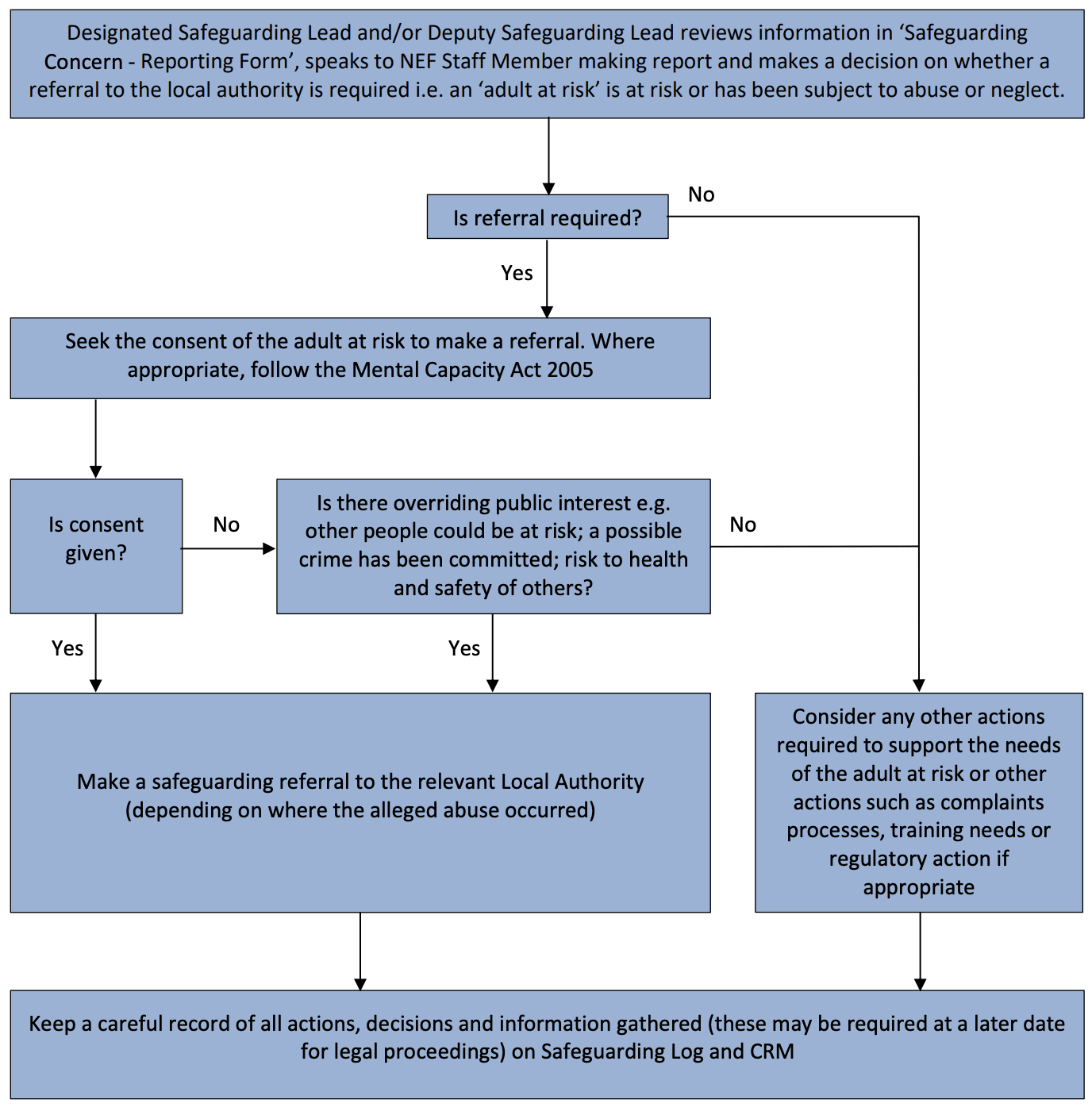
This flowchart provides a brief overview of the process for raising a safeguarding concern within NEF and for making a safeguarding referral to the local authority Safeguarding Adults Team
A concern is raised with you or you have become aware that abuse or neglect of an adult at risk has occurred, or is suspected. For the concern to fall under safeguarding it must involve an ‘adult at risk’
Ensure the immediate health, safety and welfare of the adult at risk and anyone else at risk (including the alleged perpetrator, particularly if they also have care and support needs)
In an emergency contact the relevant emergency services (police, ambulance, fire and rescue service)
Carry out initial information gathering using ‘Safeguarding Concern – Reporting Form’
Ask open questions to gather information on:
- Date, time and location of incident
- Details of alleged abuser
- Details of incident and any potential witnesses
- Consent to share information with Local Safeguarding Adults Team (not compulsory but good practice)
- Desired outcome
- Other agencies that the resident is known to (support worker etc.)
Send completed ‘Safeguarding Concern – Reporting Form’ to Designated Safeguarding Lead and/or Deputy Safeguarding Lead
Process
For Designated Safeguarding Lead and/or Deputy Safeguarding Lead:
Annex 1 – Sources of Information and Support
Hourglass Cymru– safer ageing stopping abuse
raising awareness, encouraging education, promoting research, collecting and disseminating information Welcome to Hourglass Cymru | Hourglass
Men’s Advice Line
For male domestic abuse survivors Tel: 0808 801 0327
Welsh Womens Aid
Domestic abuse & violence support for women Tel: 0808 80 10 800
Home : Welsh Women’s Aid
National LGBT+ Domestic Abuse Helpline Tel: 0800 999 5428
National 24Hour Freephone Domestic Abuse Helplines 0800 2000 247 (England)
Rape Crisis Federation of England and Wales www.rapecrisis.co.uk
Respond
Provides a range of services to victims and perpetrators of sexual abuse who have learning disabilities, and training and support to those working with them. www.respond.org.uk
True Vision -Stop Hate Crime
Works to challenge all forms of Hate Crime and discrimination, based on any aspect of an individual’s identity . Email: enquiries@report-it.org.uk ;Telephone: 0800 138 1625
Report Hate Crime – Wales – True Vision
Susy Lamplugh Trust
The Trust is a leading authority on personal safety. Its role is to minimise the damage caused to individuals and to society by aggression in all its forms – physical, verbal and psychological. www.suzylamplugh.org
Wales Victim Support
Provides practical advice and help, emotional support and reassurance to those who have suffered the effects of a crime.
Tel: 0808 168 9111 Wales – Victim Support
Women’s Aid Federation of England and Wales
A national domestic violence charity. It also runs a domestic violence online help service. https://www.womensaid.org.uk/information-support/
Version Control – Approval and Review
Version No | Approved By | Approval Date | Main Changes | Review Period |
| 1.0 | Board | June 2026 | Policy created | Annual |
Policy Owner: Alison Vickers
Policy approved by: Board of Trustees
Date Policy approved: 16/06/2026
Next review Date: 16/06/2027